
Town Courts in Medieval Britain: Editions and Translations
This page provides an annotated list, organized by town, of the proceedings of town courts in print or available online for English, Scottish, and Welsh town, up to about 1500. ‘Town’ means a chartered borough or a large settlement with a market and more than half of the residents involved in non-agricultural occupations. Town courts are defined here as meetings identified as ‘courts’ by contemporaries, which included ‘legal’ matters (such as presentments, indictments, or pleas), and operated under the authority of town officials, a definition that excludes most gild courts unless they were meetings of a gild merchant that essentially served as the town’s government.
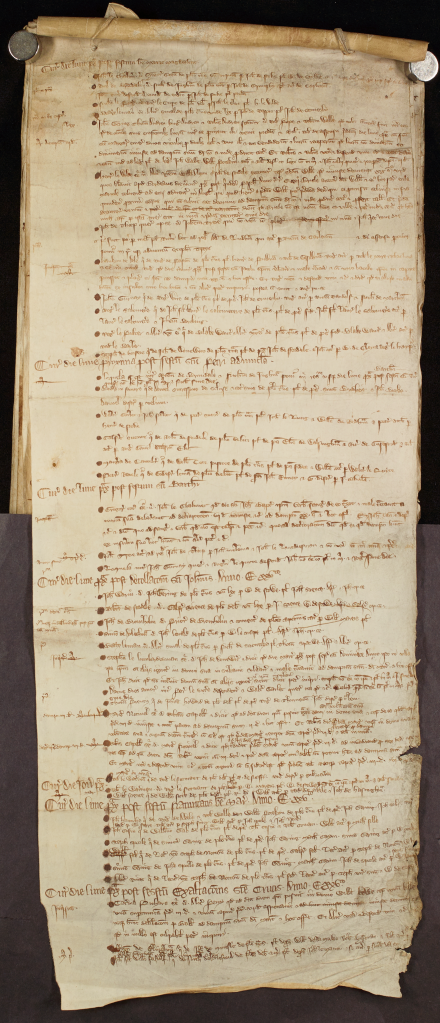
The content on this page is an updated and re-organized version, with the addition of direct hyperlinks, of: Maryanne Kowaleski, “Annotated Bibliography of Printed or Online Translations and Transcriptions of Medieval Town Courts in Britain to 1500,” Town Courts and Urban Society in Late Medieval England, 1250-1550, ed. Richard Goddard and Teresa Phipps (Boydell and Brewer, 2019), pp. 220-35. It served as an appendix to idem, “An Introduction to Borough Courts in Medieval England,” ibid., pp. 17-42. See also the other essays in this volume for analyses of aspects of borough courts.
The links here are generally to the open-access digitized print versions on archive.org and google books, or to the digital versions on British History Online. Some of these works are also available on subscription-based sites such as Haithi Trust and MEMSO. If you know of other transcribed, translated, or digitized medieval town courts to add to this list, please contact kowaleski (at) fordham (dot) edu.
Aberdeen
Aberdeen Guild Court Records 1437-1468, ed. Elizabeth Gemmill. Scottish History Society, 5th series, 17 (Edinburgh, 2005). Transcription of the proceedings of the court of the gild of the burgh, which handled both gild and burgh business, including admission of new gild members and burgesses, enforcement of gild and burgh trading regulations, leasing of burgh property, and presentments of offenses (particularly forestalling), but no personal pleas. The alderman and/or dean of the gild presided over the court, which met at least once a week in between meetings of the town council (which was elected by the gild). Entries in Latin and increasingly in Scots.
Early Records of the Burgh of Aberdeen 1317, 1398-1407, ed. William Croft Dickinson. Scottish History Society, 3rd series, 49 (Edinburgh, 1957). Latin transcripts of the burgh courts for 1317 and 1398-1400 are complete; later records include only extracts. The burgh court was presided over by the town’s four bailies, who were the king’s officials. There were three types of burgh court, each entered chronologically on the same court roll: the curia legalis met every two weeks on Mondays; three of these were head courts (curia capitalis); the most important was the Michaelmas court, at which the alderman and bailies were elected. By 1398, there were also courts held by the bailies to deal with business in between meetings of the curia legalis. The court handled personal pleas, actions begun by royal writ, registration of deeds, and limited criminal jurisdiction.
“The Aberdeen Court Roll of 1317,” Website of the Stair Society: Scotland’s Legal History Society. Includes the transcription, English translation, and images of the original text of the roll in the Early Records of the Burgh of Aberdeen 1317, 1398-1407, pp. 1-17 (above). For a description of the roll and its contents, see Andrew R. C. Simpson and Jackson W. Armstrong, ‘The Roll of the Burgh Courts of Aberdeen, August-October 1317’, in Miscellany Eight, ed. by A. M. Godfrey, Stair Society 67 (Edinburgh, 2020), 57-93.
Extracts from the Council Registers of the Burgh of Aberdeen, vol. 1: 1398-1570, ed. John Stuart. Spalding Club, 12 (Aberdeen, 1844). Extracts from the first 27 volumes of the Council Registers, which include civil and criminal court proceedings in the burgh courts and guild court, as well as Council discussions of civic policy, regulations, debts, and properties and disputes initiated by city officials or individuals, elections, royal letters, and taxes, among other matters.
‘Law in the Aberdeen Council Registers, 1398-1511,” The Aberdeen Burgh Records Project. Research Institute of Irish and Scottish Studies, University of Aberdeen, at Project funded by the Leverhulme Trust (for 2016-19) to make available online in TEI (Text Encoding Initiative) format transcripts of extant Aberdeen Council Registers; see entries above for the contents of these Registers. There are also digitized copies of these eight volumes (minus vol. 3, which is missing) available online.
Andover
‘Andover,” in Charles Gross, The Gild Merchant, vol. 2 (Oxford, 1890), pp. 3-12, 289-351. Latin transcriptions of the Morghespeche (or Maneloquium) of the gild merchant, which dealt mainly with gild business (especially admissions to membership) but which had a wider jurisdiction over other crafts and heard cases of trespass and debt, though it is unclear if the plaintiffs had to be members of the gild to bring suit. An unusual number of women appear in these courts, which date from 1262 to 1348 (along with a few extracts from the fifteenth century) and occur on Fridays. There are also transcripts from a small number of Hundred courts (1304-5) presided over by the bailiffs.
Atherstone
Select Pleas in Manorial and Other Seignorial Courts, ed. F. W. Mailtland, Selden Society, 2 (London, 1888), pp. 25-6, 40-1. Latin and facing English translation of pleas in 1285 and 1291, mostly about property, from a small Warwickshire borough of the abbey of Bec.
Barnstaple
Reprint of the Barnstaple Records, ed. J. R. Chanter and Thomas Wainwright, 2 vols (Barnstaple, 1900). Includes English translations of extracts from a variety of Mayor’s court rolls and books from the early fourteenth into the fifteenth century. An index is available at https://www.genuki.org.uk/big/eng/DEV/Barnstaple/.
Basingstoke
A History of the Ancient Town and Manor of Basingstoke in the County of Southampton, ed. F. J. Baigent and E. J. Millerd (London, 1889), pp. 221- 356. Translated extracts of the weekly Hundred court and the leet court with view of frankpledge (held twice a year), 1386-1558, including the town and manor of Basingstoke and some of the other manors in the hundred. The civic authorities farmed the town, manor and hundred from the king, which explains why the bailiffs of the town presided over both courts. A good example of how the business of a small town court was part of a larger rural area.
Bridgnorth
H. C. Maxwell Lyte, ‘The Manuscripts of the Corporation of Bridgnorth’, Report of the Royal Commission on Historical Manuscripts, Tenth Report, Appendix, pp. 424-37. Includes extracts from the town courts.
Bridgwater
Bridgwater Borough Archives, 5 vols., ed. Thomas Bruce Dilks. Somerset Record Society, 48, 53, 58, 60, 70 (Frome and London, 1933-71). The following volumes include court rolls, mainly transcripts from the original Latin, some of them also translated into English, and others only briefly summarised: 1200-1377 (1933): Latin transcript of courts of Bridgwater castle (with the manor of Haygrove), 1371-72. 1377-99 (1938): courts of the castle (with the manor of Haygrove); a Durneday court held in January (1388) when burgage holders who had failed to pay the rents due to the lord and the chaplain of Our Lady’s chantry at Michaelmas were amerced 6d; courts of the borough held before the steward of the lord regarding debts,, trespass, and other pleas, as well as (twice a year) view of frankpledge with a wide variety of presentments typical of leet courts, and profits of the piepowder court. 1400-1445 (1945) 1445-1468 (1948): court session of the common steward (1446) and extracts of the same (1453-4) including personal debt pleas. 1468-1485, ed. R. W. Dunning and T. D. Tremlett from transcripts by T. B. Dilks (1971): court of the chantry of the chantry of Holy Trinity (1473), presided over by the mayor and feoffees of the chapel and dealing with entry fines and presentments and fines for failure to repair tenements and lands of the chapel. The introductions to these volumes are available at the Bridgwater Heritage Group website.
Bristol
E. W.W. Veale, ‘Introduction,” The Great Red Book of Bristol: Text (Part III), ed. E.W.W. Veale, Bristol Record Society, 16 (Bristol, 1951), 2-55. Town courts do not survive for Bristol, but we can get some idea of the types of business in its town courts by examining writs of error in common law that required the local court to provide a record of a particular case to the appellate central court, as Veale does here.
Caernarvon
Caernarvon Court Rolls 1361-1402, ed. G. P. Jones and Hugh Owen. Caernarvonshire Historical Society Record Series, 1 (Caernarvon, 1951). Includes translations from three courts. The Great Tourn, held twice a year before the town bailiffs with the constable of the castle as chief magistrate, recorded the admission of burgesses and jurors’ presentments of minor trespasses and infringements on the town’s rights. The Town court, which met roughly every three weeks, treated personal pleas, especially debt, and the assize of bread. The fair courts dealt primarily with commercial matters arising during the fairs. The relationship between the piepowder courts and fair courts is unclear; they could have been the same.
Cambridge
Cambridge Borough Documents, vol. I, ed. W. M. Palmer (Cambridge, 1931). Latin transcription of the proceedings (mostly personal pleas) of one court in 1294 (pp. 2-6) and selected cases from subsequent courts in 1294-5 (pp. 6-10)
Canterbury
J. Brigstocke Sheppard, ‘The Records of the City of Canterbury,” Report of the Royal Commission on Historical Manuscripts, Ninth Report, Appendix, pp. 129-77. Includes extracts from the town courts.
Chester
Calendar of County Court, City Court and Eyre Rolls of Chester, 1259-1297, ed. R. Stewart-Brown. Chetham Society, new series, 84 (Manchester, 1925). English calendar of pleas of the Crown for the city for 1288-96, including felonies, trespass, nuisance, and some personal pleas of trespass and detention, held before the justiciar of Chester.
Selected Rolls of the Chester City Courts Late Thirteenth and Early Fourteenth Centuries, ed. A. Hopkins. Chetham Society, 3rd series, 2 (Manchester, 1950). Latin transcripts of proceedings in the Pentice court of 1317-18, which dealt with debts, petty crime, and misdemeanors, and was presided over by the sheriff; the Crownmote court for 1316-17, which heard crown pleas before the mayor and bailiffs; and the Portmote for 1295, 1297, 1320-21 and selected cases in 1299-1304, over which the mayor presided; it dealt with land disputes as well as trespass, debt, and covenant.
John Cordy Jeaffreson, ‘The Manuscripts of the Corporation of Chester,” Report of the Royal Commission on Historical Manuscripts, Eighth Report, Appendix, pp. 355-403. Includes extracts from the town courts.
Colchester
Court Rolls of the Borough of Colchester, 4 vols., translated and epitomized by Isaac Herbert Jeayes, with introduction and corrigenda by W. Gurney Benham (Colchester, 1921-41): Vol. I (1310-1352); vol. 2 (1353-1367), vol. 3 (1372-1379), vol. 4 (1379-83). Includes English translations of the Hundred court of Colchester, which met every two weeks and was presided over by the bailiffs to deal with personal pleas (contract, debt, detention of chattels, and trespass), actions initiated by writs regarding property disputes, and presentments of minor market infractions, among other business; a thrice-yearly Law Hundred court, which handled typical leet court presentments; and the Court of Pleas (by 1409/10 called the Foreign court), which included speedier procedure for personal pleas. Available on Haithi Trust.
Coventry
The Coventry Leet Book; or Mayor’s Register, containing the Records of the City Court Leet or View of Frankpledge, A. D. 1420-1555, ed. M. D. Harris. 2 vols. In 4 parts. Early English Text Society, 135, 138, 146 (London, 1907-13). By this period, the leet court had lost most of its judicial functions in favor of a greater legislative role in terms of ordinances and mayoral proclamations, many of which stemmed from petitions presented at the leet. Other business includes jurors’ presentments, civic elections, decisions about town lands and finances, and reviewing town accounts. In Middle English and some Latin (translated in facing column).
The Statute Merchant Roll of Coventry 1392-1416, ed. and trans. Alice Beardwood. Dugdale Society, 17 (London, 1939). Contains a record of recognizances of debt according to the Statute of Merchants (although they did not all involve merchants or commercial debts), made before the mayor of Coventry and the clerk of the statute merchant or his deputy. Cases dealing with non-payment mostly appeared in the king’s Court of Common Pleas.
Criccieth
‘The Court Rolls of the Borough of Criccieth,” ed. W. Garmon Jones, Bulletin of the Board of Celtic Studies 2 (1923), pp. 149-60. Latin transcription of seventy courts for five years between 1320 and 1330 for the Small court (curia parva), which mostly recorded fines for convictions of trespass and some debts (many courts record no business at all), along with four (very short) fair courts. There was also a ‘Great court’ whose business was similar to that of the small court, though it usually named seven jurors. Available on Haithi Trust.
Dartmouth
Dartmouth. Vol. I—Pre-Reformation, ed. Hugh R. Watkin, Parochial Histories of Devonshire, 5 (Exeter, 1935). Translated extracts from the town’s first volume of the Proceedings of the Mayor’s Court, 1484-1511 (pp. 192-255)
Doncaster
A Calendar to the Records of the Borough of Doncaster, 3 vols (Doncaster, 1899-1903). Vol. II contains the (manorial) Great Court (of the Duke of York in 1454-57 and the king in 1495-1503)) at which civic officials (including the mayor) were elected and jurors presented infractions of the assize of ale, nuisances, and assault. After 1505, when the town became a borough, the business of what was called the Great court with view of frankpledge expanded. It is unclear whether the printed proceedings are extracts or a complete transcription.
Durham
Records of the Borough of Crossgate, Durham 1312-1531, ed. Richard Britnell. Surtees Society, vol. 212 (Woodbridge, 2008). Latin transcriptions of court rolls (including leet courts) from 1312 and 1390-1400 and court books covering 1498-1531. Crossgate, one of four jurisdictions in the town of Durham, was in the lordship of Durham Priory.
Faversham
Henry Thomas Riley, ‘The Corporation of Faversham,” Report of the Royal Commission on Historical Manuscripts, Sixth Report, Appendix, pp. 500-11. Includes extracts from the town courts.
Gloucester
W. H. Stevenson, ‘The Records of the Corporation of Gloucester,” Report of the Royal Commission on Historical Manuscripts, Twelfth Report, Appendix, pp. 400-529. Includes extracts from the town courts.
Grimsby
Alfred Gibbons, ‘The Corporation of Great Grimsby,” Report of the Royal Commission on Historical Manuscripts, Fourteenth Report, Appendix, pp. 237-91. Includes extracts from the town courts.
Hedon
J. R. Boyle, The Early History of the Town and Port of Hedon, in the East Riding of the County of York (Hull, 1895). Includes extracts in Latin from the Communitas, the c. 1360 court of the burgesses in the footnotes to provide evidence on observations made in the main text. There were other courts, including a Court of Pleas, but Boyle makes far less use of them.
Henley
Henley Borough Records. Assembly Books i-iv, 1395-1543, ed. and trans. P. M. Briers. Oxfordshire Record Society, vol. 41 (Banbury, 1960). Includes admissions of burgesses, election of civic officials, enrolment of property transactions, ordinances on sanitation and trading, and accounts of borough officials. Offenders were brought for punishment to the court of the lord of the manor, which was coterminous with the borough. Latin transcript, with entries increasingly in English from the 1490s onward.
Hereford
William Dunn Macray,’The Manuscripts of the Corporation of Hereford,” Report of the Royal Commission on Historical Manuscripts, Thirteenth Report, Appendix, pp. 292-302. Includes extracts from the town courts.
Hythe
Henry Thomas Riley, “The Manuscripts of the Corporation of Hythe, Kent,” Report of the Royal Commission on Historical Manuscripts, Fourth Report, Appendix, pp. 429-39. Includes extracts from the town courts.
Ipswich
The Ipswich Recognizance Rolls 1294-1327. A Calendar, ed. G. H. Martin. Suffolk Records Society, vol. 16 (Ipswich, 1973). Originally enrolled in the Portmanmote (later called the Great court) and the court of petty pleas, these transfers of title to burgage tenements and proof of testaments were recorded separately by the early fourteenth century in what came to be known as the Petty court of recognizances. Particularly interesting are the formal renunciations by wives of title. The conveyances and testaments are translated into English, but the headings of the rolls and marginal notes by the clerks are in the original Latin.
John Cordy Jeaffreson, The Manuscripts of the Corporation of Ipswich, co. Suffolk,” Report of the Royal Commission on Historical Manuscripts, Ninth Report, Appendix, pp. 222-62. Includes extracts from the town courts.
King’s Lynn
The Making of King’s Lynn. A Documentary Study, ed. Dorothy M. Owen. British Academy Records of Social and Economic History, new series, 9 (London, 1984). Latin transcription of pleas (assault and debt) in the Monday court for the southern half of the town (pp. 409-11); extracts (personal pleas) from a Stewards’ Hall court in 1318 for Newland (pp. 411-14); details of litigants and procedure in an account of profits of the Hustings court in 1347, when the courts were in royal hands (pp. 414-18); selected presentments and orders at leet courts (pp. 419-22); coroner’s inquests, 1291-1304; and gaol delivery before the justices of the peace, including the mayor (pp. 429-30).
John Cordy Jeaffreson, “The Manuscripts belonging to the Corporation of the Town of King’s Lynn,” Report of the Royal Commission on Historical Manuscripts, Eleventh Report, Part III (London, 1887), pp. 145-247. Includes extracts of court rolls.
Lanark
Extracts from the Records of the Royal Burgh of Lanark with Charters and Documents Relating to the Burgh. A.D. 1150-1722 (Glasgow, 1893), pp. 1-10. Proceedings of the borough court and head court of the borough (curia capitalis burgi), both held by the bailiffs, in Scots with Latin headings, for 1488, 1490, 1498, and many years in the sixteenth century and beyond. The extracts (it is unclear how much of the original records are printed here) consist mainly of property transfers and disputes, burgess entries, and burgh business, including the filing and auditing of accounts, rents on town property, and occasionally presentments for market infractions.
Launceston
The Histories of Launceston and Dunheved in the County of Cornwall, ed. Richard Peter and Otho Bathurst Peter, (Plymouth, 1885), pp. 116-23 passim. English translation of extracts from the Mayor’s courts of 1413, 1418, 1420, 1430.
Leicester
Records of the Borough of Leicester: Being a Series of Extracts from the Archives of the Corporation of Leicester, ed. Mary Bateson, revised by W. H. Stevenson and J. E. Stocks. Vol. I: 1103-1327; vol. II: 1327-1509 (London, 1899-1901). Extensive extracts in Latin with English translations of the Gild Merchant Rolls (the first is for 1196-1225), also called Pleas of the Merchant Gild and the Morningspeech, which heard presentments of market offenses and pleas of debt and trespass, as well as recording gild admissions, fines, and trade ordinances. Vol. II also includes proceedings of the burgesses’ court of record (for 1378-9 and a fragment from 1269-70), called the Portmanmoot (the first c. 1260, is in vol. I), which heard personal and property pleas and met weekly by 1377, when its profits were transferred from the Earl of Leicester to the borough, along with a fragment of a frankpledge (1443) and pleas in a fair court (1347, 1446). There are coroners’ rolls in Vol. I (1297-1327) and II (1327) noted as pleas of the crown, but the coroners were two burgesses.
London
Calendar of Early Mayor’s Court Rolls Preserved among the Archives of the Corporation of the City of London at the Guildhall A.D. 1298-1307, ed. A. H. Thomas (Cambridge, 1924). The only surviving rolls of the Mayor’s court, though some later proceedings are recorded in the Letter Books and the Plea and Memoranda Rolls. Originating in the thirteenth century, it became the city’s most important court for personal actions, especially debt. It did not deal with cases involving property ownership.
Courts of Common Council and Aldermen Calendar of Letter-Books Preserved Among the Archives of the Corporation of the City of London at the Guildhall. Ed. R. R. Sharpe, 11 vols (A-L) (London, 1899-1912). English calendar of the entries in the eleven extant medieval Letter Books, which contain much miscellaneous business of the city of London, including parts of the pre fifteenth-century proceedings in the Court of Common Council (later recorded in the Journals, which are only in manuscript) and the Court of Aldermen (later recorded in the Repertories, which are also in manuscript). The Letter Books also contain other legal material such as debt recognizances, deeds, ordinances, and the assize of bread. The memoranda are often recorded out of chronological order by a variety of clerks, but each volume largely relates to a specific period, as follows: A: 1275-1298; B: 1275-1313; C: 1291-1309; D: 1309-1314; E: 1314-1337; F: 1337-1352; G: 1352-1375; H: 1375-1399; I: 1400-1422; K: 1422-1461; L: 1461-97. Letter Book J was lost by c. 1541, and there is no Letter Book J. Digital editions are available on BHO and Google Books and electronic pdfs on the subscription-based MEMSO.
Calendar of the Plea and Memoranda Rolls of the City of London, 6 vols. Vols. 1-4 ed. A. H. Thomas: Vol. 1: 1323-1364 (London, 1926); Vol. 2: 1364-1381 (London, 1929); Vol. 3, 1381-1412 (London, 1932). Vol. 4: 1413-1437 (London, 1943). Vols. 5-6 ed. Philip E. Jones: Vol. 5: 1437-1457 (Cambridge, 1954); Vol. 6: 1458-1482 (Cambridge, 1961). Detailed abstracts of actions in the Mayor’s court that medieval clerks chose to include as legal precedents or as examples of the city’s rights. Latin entries are translated into English, but entries are increasingly in Middle English. Vol. 3 is titled Calendar of Select Pleas and Memoranda of the City of London because it excludes smaller debt actions and some formal entries. Vol. 4 contains presentments of the Wardmotes in 1422 and 1423. Valuable introductions on specific issues are included in each volume.
For the original Middle English pleadings of the Plea and Memoranda Rolls, see theextracts from 1412, 1414-15, wardmotes in 1422 and 1423, and a bill in 1425, printed in A Book of London English 1384-1425, ed. R. W. Chambers and M. Daunt (Oxford, 1931), 118-36, 253-6.
D. L. Boyd and R. M. Karras, “The Interrogation of a Male Transvestite Prostitute in Fourteenth-Century London,” GLQ: A Journal of Lesbian and Gay Studies 1 (1995): 459-65. Includes a transcript and translation of a case in London’s Plea and Memoranda Roll A34), which was left out of the published version. The case includes testimony from John Rykener, “calling himself Eleano ,” who dressed like a woman and worked as a female prostitute but also claimed to have had sex with many women. The case is also included and further discussed in R. M. Karras and D. L. Boyd, “‘Ut cum mulier,’: A Male Transvestite in Fourteenth-Century London,” in Premodern Sexualities, ed. L. Fradenburg and C. Freccero (New York, 1996), 99-116.
Calendar of the Wills Proved and Enrolled in the Court of Husting, London, ed. R. R. Sharpe Part I: 1258-1358 and Part II: 1358-1688 (London, 1889-90). The Court of Husting, the oldest civic court in London, originally handled a wide variety of business, but personal pleas were moved to other courts as the city’s population expanded. By the late thirteenth century, the Hustings court was mainly used for wills and conveyances of land. These volumes print English abstracts of the wills, which focus primarily on bequests of rents and tenements in London, so properties outside London, chattels, and personal goods are rarely mentioned in the Husting court version of the will. The Introduction to Part I discusses the business and procedure of the Court; the Introduction to Part II focuses mainly on the bequests. The main text includes English abstracts of the wills enrolled in the Court. In addition to the version on British History Online, there are online versions available via archive.org as Part I and Part 2 and on Haithi Trust. There is also a microfilm edition of transcripts of more than 22,600 deeds and testaments in the Hustings Rolls, published by Chadwyck-Healey; see G. H. Martin, The Hustings Rolls of Deeds and Wills, 1252-1485: Guide to the Microfilm Edition (Cambridge, 1990); the set of 30 reels of microfilm also includes the London Archives’ indices of names and places, as well as calendars of deeds and wills in London.
London Assize of Nuisance 1301-1431: A Calendar, ed. Helena M. Chew and William Kellaway, London Record Society, vol. 10 (London, 1973). English abstracts of complaints regarding offenses against the city’s assizes of buildings and nuisance, held before the mayor and twelve aldermen. The complaints usually pitted neighbor against neighbor over encroachments caused by cesspits, gutters, and walls; the right to privacy; and danger from fire, among other issues. The procedures to be followed for complaints are also clearly set out.
London Possessory Assizes: A Calendar, ed. Helena M. Chew, London Record Society, vol. 1 (London, 1965). English translations of the assizes of novel disseisin (known in London as assize of fresh force) and a few cases of mort d’ancestor held before the sheriffs and coroners, 1340-1451, with individual pleas for 1317, 1380, and 1470 calendared in the appendix. Plaintiffs initiated the complaint (which could involve lands, tenements, or rents) at the Monday session of the Hustings Court of Pleas, but it was heard before a jury impaneled by the sheriffs.
“The Portsoken Presentments: An Analysis of a London Ward in the 15th Century,” by Christine Winter. Transactions of the London and Middlesex Archaeological Society, 56 (2005), 97–161. English translation of mainly nuisance indictments made by the jurors of a London suburban wardmote for fourteen years, 1465-83. The jurors’ presentments focus in particular on fire hazards and on prostitutes and their maintainers.
Extracts from the original Middle English wardmotesin 1422 and 1423 are printed in A Book of London English 1384-1425, ed. R. W. Chambers and M. Daunt (Oxford, 1931), 118-36, 253-6.
“The London Sheriffs’ Court Roll of 1320,” ed. Matthew Stephens (London: Centre for Metropolitan History, 2010). This is the only roll of the Sheriffs’ Court to survive, probably because the proceedings were considered the property of the Sheriff, even after the end of his annual term. The original roll is in Latin and contains 26 membranes; the (unattributed) translation has been checked against the original by the editor. The roll contains c. 1590 entries covering c. 550 disputes heard before sheriff John de Preston over almost three months. About 60 per cent of the cases involve debt and 30 per cent trespass. Also includes a helpful introduction, and indices of personal names and cases by plaintiff surnames. From London Metropolitan Archives, CLA/025/CT/01/001 & 002.
Susanne Jenks, “Picking up the Pieces: Cases Presented to the London Sheriffs’ Courts between Michaelmas 1461 and Michaelmas 1462,” Journal of Legal History 29 (2008): 99-145. Although the sheriffs’ court was the busiest court in London, very few of its proceedings survive. We can, however, get some idea of the types of business in its town courts by examining writs of error in common law that required the local court to provide a record of a particular case to the appellate central court, as appears in the list created by Jenks of these cases.
Melcombe Regis
Henry Thomas Riley, ‘The Manuscripts of the Towns of Weymouth and Melcombe Regis,” Report of the Royal Commission on Historical Manuscripts, Fifth Report, Appendix, pp. 575-90. Includes extracts from the town courts.
New Romney
Henry Thomas Riley, “The Manuscripts of the Corporation of New Romney,” Report of the Royal Commission on Historical Manuscripts, Fourth Report, Appendix, pp. 439-42, and idem, “Court Books of the Corporation of New Romney,” Report of the Royal Commission on Historical Manuscripts, Sixth Report, Appendix, pp. 540-45. Includes extracts from the town courts.
Norwich
Leet Jurisdiction in the City of Norwich during the XIIIth and XIVth Centuries, ed. William Hudson, Selden Society, 5 (London, 1892). Facing page Latin and English translation of ten leet courts (1288-1313, 1375, 1391), amercements at a leet in 1364, and a roll of pleas before the bailiffs (1350).
The Records of the City of Norwich, vol. I, ed. William Hudson and John Cottingham Tingey, (Norwich, 1906). Includes extracts in Latin (with English abstracts) of conveyances enrolled in the City court, 1287-98; and English translation of selected civil pleas in the City court, 1329-79 and 1404; selected sessions of the peace and of enquiry, and gaol delivery before various civic officials (1423-16th century); examples of litigation in the fiteenth century; and extracts from the leet courts, 1288-1391.
Nottingham
Nottingham Borough Court Rolls, trans. Trevor Foulds and J. B. Hughes. An impressively full calendar in English of all entries (except for the fourteen annual courts from 1303/4 to 1335/6, which still extract well over 10,000 pleas in this period) for c. 85 years from 1303 to 1455. Includes rolls for Burgess Pleas and Foreign Pleas (for cases in which one of the litigants was not a city resident). Nottingham has one of the most continuous runs of medieval borough courts, and this project represents by far the most complete transcriptions available of the genre. For more on the courts, see the website’s user’s guide by Richard Goddard.
Records of the Borough of Nottingham, being a series of extracts from the Archives of the Corporation of Nottingham, ed. William Stevenson. 4 vols (London, 1882). Vol. 1 covers 1155-1399, vol. 2, 1399-1485, and vol. 3, 1485-1547. There is a gap in 1457-1481, after which the courts are recorded less carefully in paper books.
Oxford
Munimenta civitatis Oxonie, ed. H. E. Salter. Oxford Historical Society Publications, 71 (Devizes, 1920). Latin transcripts made by Brian Twyne (d. 1644), with some translations, of a variety of documents, including extracts from chamberlains’ accounts, 1306-1545.
Oxford City Documents Financial and Judicial 1268-1665, ed. J. E. Thorold Rogers. Oxford Historical Society, 18 (Oxford, 1891). Includes Latin transcripts of selected coroner’s inquests, 1297-1303, 1306-7, 1314, 1319-22, and inquests before the alderman of South ward (1423), the mayor and bailiffs (1428). Full transcript of the 1285 eyre held in the borough and a 1402 inquest before the mayor on thefts and receivers of stolen goods, among other crimes.
‘The View of Frankpledge,” in H. E. Salter, Medieval Oxford. Oxford Historical Society, 100 (Oxford, 1936), pp. 146-53. Latin transcripts made by Brian Twyne (d. 1644) of now lost records; extracts of presentments in eleven courts of frankpledge, 1405-1516.
Peebles
Charters and Documents relating to the Burgh of Peebles with Extracts from the Records of the Burgh. A.D. 1165-1710, ed W. Chambers. Scottish Burgh Records Society, 10 (Edinburgh, 1872), pp. 111-99. Extracts in Middle Scots, 1456-98, from the court of the burgh (sometimes called the ‘Head court’), held before two bailiffs in the tollbooth. Proceedings mainly include burgess entries and notices of leases and repair of city properties, appointment of town officers, and by-laws, especially on commercial matters. Little litigation recorded in these extracts, but there are inquests, most of which concern landed property.
Peterborough
Peterborough Medieval Court Rolls, trans Margaret Briston, introduction by Nicholas Karn. Northamptonshire Record Society, 48 (2015). Prints English translations of entire courts, including the leet courts (28 from 1359 to 1538) with presentments of the tithingmen of the town’s five wards; the Portmanmoot court (for 5 years, 1397-1425), which focused heavily on transfers of property; and the Market court (four survive for short periods in 1397-1426), which dealt with personal pleas of all types, but especially debt. Also includes manorial courts of Peterborough estates.
Ramsey
The Court Rolls of Ramsey, Hepmangrove and Bury, 1268-1600, ed. and trans. E. B. DeWindt (Toronto, 1990). Transcripts of views of frankpledge for the small town of Ramsey, including presentments by ale-tasters. Also includes some leet courts and pleas in the courts of the banlieu of the Abbot of Ramsey (some with coroners’ inquests, pleas of oyer and terminer, assizes, and gaol deliveries). The courts often include the nearby villages of Hepmangrove and Bury. Full transcripts are available in microfiche at the back of the book.
Ruthin
The Court Rolls of the Lordship of Ruthin or Dyffryn-Clwydd of the Reign of King Edward the First, ed. R. A. Roberts. Cymmrodorian Record Series, 2 (London, 1893). Includes courts of the borough of Ruthin, presided over by the constable of the castle. Latin (replicating the abbreviations of the original hand) with facing page English translation of 1294-95; the remaining court rolls are simply summarized in English.
The Dyffryn Clwyd Court Roll Database, 1294-1422, ed. R. R. Davies, L. B. Smith, A.D.M. Barrell, O. J. Padel, and M. H. Brown. [data collection, 1997]. UK Data Service. SN: 3679. A downloadable dataset (once you create an account and log in) containing an English language calendar of the Latin court rolls of the lordship of Dyffryn Clwyd, which includes the town of Ruthin. See also the User Guide.
Rye
Henry Thomas Riley, The Manuscripts of the Corporation of Rye’, Report of the Royal Commission on Historical Manuscripts, Fifth Report, Appendix, pp. 488-516. Includes extracts from the town courts.
Southampton
The Common and Piepowder Courts of Southampton, 1426-1483, ed. Tom Olding. 2 vols. The Ames Foundation and Southampton Records Series, 44, 45 (Bristol, 2011). English translations of Latin proceedings in the Town court, which by the fifteenth century was divided into three sessions. The Common court met weekly to hear personal pleas and presentments by town officials. The Piepowder court also heard personal pleas, but primarily involving those not resident in Southampton, and administered a swifter justice. Only one record of the court to hear land pleas survives (for the late 14th century). Digital images of the original manuscripts of these records are available at the Ames Foundation website.
John Cordy Jeaffreson, “The Manuscripts of the Corporation of the Town of Southampton,” Report of the Royal Commission on Historical Manuscripts, Eleventh Report, Part III (London, 1887), pp. 1-144. Includes extracts from court rolls.
Stafford
F. B. Stitt, ed. and trans, ‘Stafford Borough Court Rolls 1396-7,” in Old Stafford: Essays Presented to J. Sidney Horne, Transactions of the Stafford History and Civic Society (1974-6), pp. 15-35. English translation of one leet court (called the Great court) with the usual presentments made by a jury of twelve, and fourteen meetings of the ‘small court’ or courts baron, which heard civil pleas (mostly debt and trespass) and met on Mondays. The editor usefully distinguishes marginal and interlinear material.
Stamford
William Browne’s Town. The Stamford Hall Book Volume I: 1465-1492, ed. Alan Rogers (Stamford, 2005). The contents include proceedings of the Thursday court of the Alderman (the chief official of the borough), which include admissions to the freedom, elections, warrants to keep the peace issued in response to particular suits, personal pleas (mostly debt), some recognizances, and civic ordinances. The court was also called ‘sessions of the peace’. English translations of Latin, with some Middle English.
Tamworth
Court Rolls of Tamworth, trans M. K. Dale. Unpublished typescript (Tamworth, 1959). Translated selections from views of frankpledge and the Portmanmoot court, 1289-1320. Available at the University of London, Institute of Historical Research (UK). For an introduction to the microfilm of the court rolls, see Robin Studd, ‘The Tamworth Court Rolls: An Introduction to the Colour Microfiche Edition Published by Ormonde in 1987.”
Totnes
The History of Totnes Priory & Medieval Town, Devonshire, ed. Hugh R. Watkin. 3 vols (Torquay: privately published, 1914-17); vol 1 is a chronological record; vol. 2 is a narrative history with embedded documents and many document facsimiles; vol. 3 is an index. English translation of a wide variety of feudal, manorial, borough, and ecclesiastical documents. Includes proceedings of the Court of the Community of the Borough (also called the Court of the Community of the Guild Merchant), when it was presided over by the senior steward of the merchant guild. This steward had become the mayor by 1359, after which the court was titled the Law court of the Mayor. There are proceedings extant from 1313 (with a gap from 1345 to 1404), but they are concerned mainly with guild business, particularly admissions to the guild. The courts extant from 1405 include a wider range of business.
Henry Thomas Riley, ‘The Corporation of Totnes,” Report of the Royal Commission on Historical Manuscripts, Third Report, Appendix, pp. 341-50. Includes extracts from the town courts.
Wallingford
‘Extracts from the Earliest Datable Roll of the Town Assembly (burgimotus) of Wallingford.’ In Elenchus Fontium Historiae Urbanae, vol. 2, part 2. The United Kingdom, Ireland, ed. Susan Reynolds, Wietse de Boer, Gearóid Mac Niocaill (Leiden, 1988), pp. 121-3. Latin transcript of the earliest dateable court,1231-32, called the Burgimote, held on Thursdays. The seven court sessions include essoins, personal pleas, and prices set for the assize of ale and bread.
Henry Thomas Riley, ‘The Corporation of Wallingford,” Report of the Royal Commission on Historical Manuscripts, Sixth Report, Appendix, pp. 572-95. Includes extracts from the town courts.
Weymouth
Henry Thomas Riley, ‘The Manuscripts of the Towns of Weymouth and Melcombe Regis,” Report of the Royal Commission on Historical Manuscripts, Fifth Report, Appendix, pp. 575-90. Includes extracts from the town courts.
Winchester
J. S. Furley, Town Life in the XIV Century as Seen in the Court Rolls of Winchester City (Winchester, 1947). Pages 114-61 includes extracts in Latin with English translations, organized under headings to illustrate the jurisdictional reach, procedure, and different types of personal pleas and presentments made by aldermen and jurors.
.Henry Thomas Riley, ‘The Corporation of Winchester,” Report of the Royal Commission on Historical Manuscripts, Sixth Report, Appendix, pp. 595-605. Includes extracts from the town courts.
York
Sheriffs’ Court Books of the City of York for the Fifteenth Century, trans. P. M. Stell (York, 2000.) English translation of Sheriffs’ courts (1471-79), sessions of the peace (1498-1500), accounts of court expenses, and custumal (c. 1415-33) of the Sheriff’s court.